A UK vet explains when it may be time to say goodbye, what euthanasia involves, whether to stay present, and how to find aftercare and pet loss support.
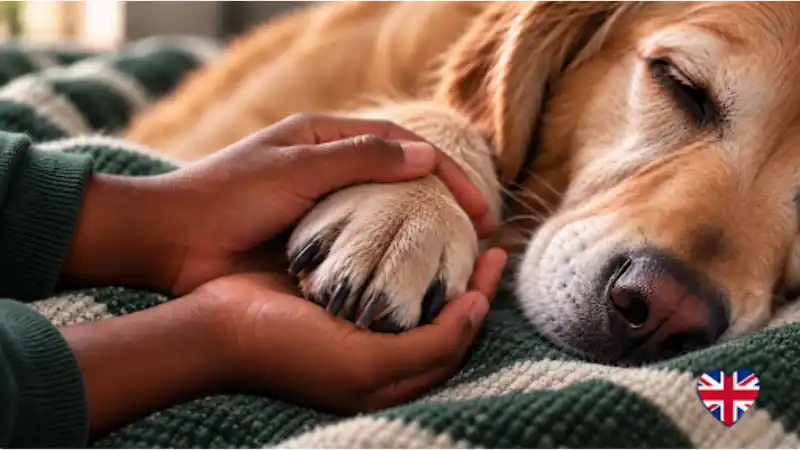
In Britain we do not usually use the word itself; instead we speak of 'putting them to sleep', of 'letting them go', or of a pet being 'helped on their way'. People regard this as an attempt to avoid the issue, and there may be some truth in that, but after all the years I have been involved in practice I have come to believe that our national tendency towards mild language captures something genuine about the procedure itself. When euthanasia is carried out properly it is quiet, peaceful and kind, and the gentle phrases that we use are not mainly a means of avoiding what is taking place but rather a fairly accurate description of it.
It is not uncommon for pet parents to apologise to me whether it is for crying, for asking the same question twice, or for taking up my time on a busy evening, and I would really like to be able to make it clear to all of them that an apology in such situations is unnecessary. Helping a much-loved animal to a peaceful end and supporting their family during that time is not a disruption to my work but in fact some of the most important work I do.
There are, in fact, very few instances where a decision is made on our behalf. If a pet suffers a catastrophic injury or falls ill suddenly in a way that cannot be treated, there is no real option left, and even though those days are difficult, the family can still keep the peace of mind that no other course of action was possible.
More frequently than not, the decision is made gradually, for example in the case of an old dog whose kidneys are failing or a cat for whom the medication for arthritis is no longer giving her any comfort. There is not a single morning on which everything suddenly changes; rather, it is the result of a long sequence of small losses, and a pet parent lying awake, wondering if today is the day. In my experience, this phase of waiting tends to have a greater impact on a family than the actual goodbye.
If families come to me and want to know how to tell whether this is happening, I advise them to consider the everyday routines. Does he still get up to say good day to you at the door, and does she still ask for her walk, go around the garden in the sun, or jump onto her usual chair? Both appetite and pain are important, but it is the gradual disappearance of these little daily pleasures that usually gives us the clearest indication. A good thing to do is to keep a simple record of ordinary days and unpleasant days, and when the number of unpleasant days starts to exceed that of the good ones, then it is time to have an honest talk with your vet.
Among vets there has been a saying for many generations: it is better to act a day early than an hour late. Although many pet parents have said that they feared they had acted too quickly, upon reflection almost all of them had not. It is usually the ones who waited who remain with the sense of regret.
When you understand how the procedure works, a great deal of the fear it causes disappears. Generally, your vet will insert a small cannula into a vein in your pet's front leg, and in many cases will ask to take your pet into another room to do so, since most animals are easier to handle when they are away from the people they instinctively want to protect. If your pet is frightened or is in pain, a sedative can be administered first so that they are already drowsy and calm before any other steps take place.
The anaesthetic used in the euthanasia injection is given in such a quantity that your pet immediately falls asleep, typically after a few seconds, and then their heart stops a short time later. The injection causes no pain, and while you might observe a deep last breath, a small muscle twitch, or the emptying of the bladder or bowels, these are merely reflexes and not indications that your pet is aware. The knowledge that such things can occur helps to avoid unnecessary distress for many families.
A positive change in this country is the availability of choice. Although the majority of euthanasias still happen at the practice, usually in a quiet room which has been allocated for that purpose and at a time of day when the waiting room is empty, home-visit euthanasia is now widely available all over the UK, whether through your own practice or via a specialist home service. Many pets find real comfort in falling asleep in their own bed, in a familiar spot in the sunshine, with the kettle on in the room next door.
It is up to you to make the decision, and only you can decide that. Although some pet parents would like to be there for every single moment, having a hand on their dog's familiar side right until the end, others realise that they cannot stand watching and therefore prefer to say their goodbyes in advance. I have helped families in all sorts of situations, whether or not children were present and whether or not the other dogs in the house lay quietly in the corner, and there is no correct answer, only what is right for you.
I am certain that no animal is ever left on its own: if you decide not to stay, a member of the veterinary team will hold your pet, speak to them in a gentle manner, and treat them in the same tender way that you would, and if you ever feel pressured in either direction, you have the right to look for a practice that will respect your wishes.
Your vet team will assist you in deciding what to do next. In most cases, families in the UK prefer cremation, which can be either communal or individual, and if you wish, the ashes can be returned to you in a casket or placed in a scatter box. Burial at home is usually allowed for pets in the UK on the condition that you own the land, but it is advisable to get advice from your vet about how to carry out such a burial safely, especially following euthanasia.
There is also the sorrow involved, and this should be taken just as seriously as any other kind of bereavement; since it is frequently accompanied by guilt about the decision, be kind to yourself and speak to your vet, as your questions will not seem unusual.
The Blue Cross Pet Loss Support service is free and confidential on 0800 096 6606, open from 8.30 a.m. to 8.30 p.m. every day and staffed by trained volunteers who have themselves experienced loss. Nobody should feel embarrassed to make use of it.
Our pets give us love which we in turn show them every day of our lives, with the single serious responsibility that when the time comes we must not make them suffer because of ourselves. A peaceful farewell is not equivalent to giving up on them; it is in fact the final act of care in a lifetime of caring.
If you are considering this choice at the present time, please do not go through it by yourself. Ask your vet all the questions that you need to ask, take as much time as you are able to take, and afterwards recall that grief of this kind is the natural result of having had a long and happy companionship, and that you fulfilled your promise right to the end.