Discover simple, science-backed ways to deepen your bond with your dog, from walks and play to positive training, puzzle games, cuddling, and quiet time.

What if the simplest things you do with your dog are also some of the best ways to strengthen your bond? Research suggests these everyday activities can build trust, improve cooperation, and deepen your connection.
Studies show that participating in shared activities strengthens the human-dog bond by providing quality time together (Darling et al 2026; Halling et al 2026). By choosing an outdoor activity and letting your dog sniff and explore, it also reduces stress and fulfills their natural curiosity (Halling et al 2026). Try switching up your route to make the activity more stimulating for both of you.
Too cold to head outdoors? Interactive indoor games such as fetch, tug-of-war, or hide-and-seek aren’t just fun - they’ve been shown to build trust and improve your dog’s confidence (Jensen et al 2026). Tug-of-war, for example, has been shown to enhance cooperation without increasing aggression when played fairly (Rooney & Bradshaw 2002).
Training sessions that rely on positive reinforcement, such as treats or praise, are much more likely to strengthen the human-dog bond compared to using negative reinforcement. Research has also shown that dogs trained this way are more eager to engage and learn, making training sessions a bonding opportunity (Vieira de Castro 2019; Martin et al 2025).
Building a simple agility course at home with items like cushions, chairs, or broomsticks can provide your dog with both mental and physical stimulation. Research suggests that such problem-solving activities can reduce stress and increase your dog’s trust in you (Tananaeva & Udell 2026).
Touch plays a crucial role in strengthening bonds. Studies have shown that activities such as brushing, petting, or cuddling your dog increase oxytocin levels (the “love hormone”) in both dogs and humans, fostering trust and emotional connection (Koskela et al 2024; Odendaal & Meintjes 2003; Nagasawa 2015).
Puzzles and problem-solving tasks engage your dog’s brain and can reduce stress. Lowering stress through cognitive enrichment helps facilitate bonding (Tananaeva & Udell 2026). This can be as simple as hiding treats under cups or rolling them into a towel to encourage your dog to think critically. If you partake as well in the puzzle activity with your dog, that engagement further promotes a deep connection (Tananaeva & Udell 2026; Jensen et al 2026).
Doing small or big adventures with your dog supports a strong co-constructed partnership (Bowden & Halling 2026; Martin et al 2025). Spending extended time outdoors, such as on a camping trip, creates opportunities for these shared experiences and reliance on each other. Activities like hiking and camping help solidify your partnership.
Learning a new trick or activity, such as “roll over” or biking or surfing, stimulates your dog’s mind and enhances communication and confidence. Studies support that training is most effective when it’s fun, helping your dog associate learning with positive interactions with you (Vieira de Castro et al. 2019, 2020).
Science has shown that dogs synchronize their stress levels with their pet parents. Sharing quiet moments while attentive to your dog, whether lounging on the couch or enjoying nature, promotes relaxation, reduces stress, and strengthens your emotional bond (Odendaal & Meintjes 2003; Koskela et al 2024; Nagasawa 2015).
What’s your favorite way to bond with your dog? Share it in the comments - we’d love to hear your story!
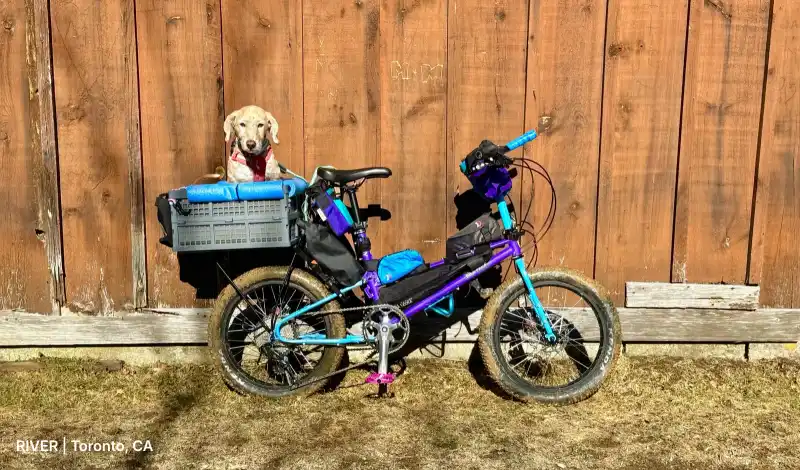
Dr. Krista Halling (DVM, DACVS, CCRP, HABC) is a board-certified veterinary surgeon, certified canine rehabilitation practitioner, and published researcher in the human-animal bond, working to advance the emerging field of veterinary lifestyle medicine. As the founder of Dogpacking.com, Krista helps people give their dogs healthier, richer lives through shared outdoor experiences. She also helps veterinary professionals apply evidence on movement, nature, and connection to improve canine health and well-being. Krista and her mini goldendoodle sidekick, River, love traveling and exploring the outdoors together.
Darling, S., Wanser, S. H., Jiang, MacDonald, M., & Udell, M. A. (2026). Better together: An attachment perspective on mutual well-being in animal-assisted interventions (AAIs). Human-Animal Interactions, 14(1), 0043.
Bowden, M., & Halling, K. B. (2026). The hominin-canine axis: A biosemiotic model of co-regulation in the human-dog dyad. Biosemiotics, 1-24.
Halling, K. B., Bowden, M., Pretty, J., & Ogeer, J. (2026). Bonded Green Exercise: A One Health Framework for Shared Nature-Based Physical Activity in the Human–Dog Dyad. Animals, 16(2), 291.
Jensen, P., Persson-Werme, C., & Roth, L. S. (2026). Play interactions improve the dog–owner relationship. Royal Society Open Science, 13(4), 1-11.
Koskela, A., Törnqvist, H., Somppi, S., Tiira, K., Kykyri, V. L., Hänninen, L., ... & Kujala, M. V. (2024). Behavioral and emotional co-modulation during dog–owner interaction measured by heart rate variability and activity. Scientific Reports, 14(1), 25201.
Martin, L., Otis, C., Lussier, B., & Troncy, E. (2025). A conceptual framework for the co-construction of human–dog dyadic relationship. Animals, 15(19), 2875.
Nagasawa, M., et al. (2015). Oxytocin-gaze positive loop and the coevolution of human-dog bonds. Science, 348(6232), 333-336.
Odendaal, J. S. J., & Meintjes, R. A. (2003). Neurophysiological correlates of affiliative behaviour between humans and dogs. The Veterinary Journal, 165(3), 296-301.
Rooney, N. J., & Bradshaw, J. W. S. (2002). An experimental study of the effects of play upon the dog–human relationship. Applied Animal Behaviour Science, 75(2), 161-176.
Tananaeva, A., & Udell, M. A. (2026). Enrichment as a Form of Stress Management in Pet Dogs. In Canine Science: An Interdisciplinary Look at Our Best Friend (pp. 343-366). Cham: Springer Nature Switzerland.
Vieira de Castro, A. C., et al. (2019). Carrots versus sticks: The relationship between training methods and dog-owner attachment. Applied Animal Behaviour Science, 219, 104831.
Vieira de Castro, A., et al. (2020). Does training method matter? Evidence for the negative impact of aversive-based methods on companion dog welfare. PLOS ONE, 15(12), e0225023.