Cats instinctively hide illness, so early signs are easy to miss. Learn why cats conceal sickness and how knowing your cat's normal helps you spot problems.

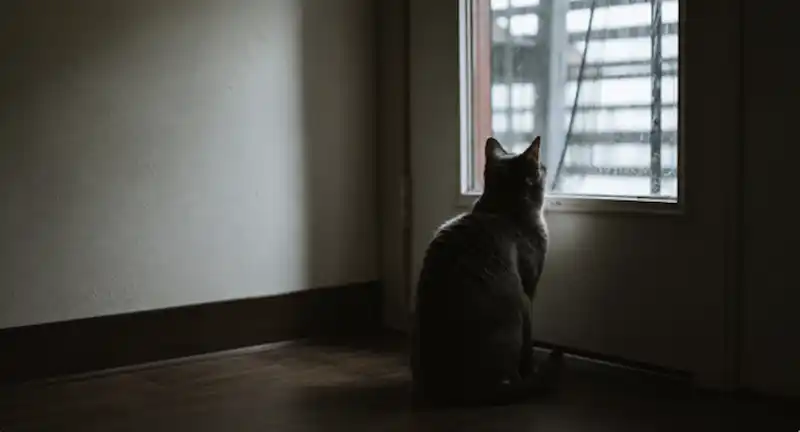
By the time a cat looks unwell to the people who love her, she has usually been unwell for a while. This is one of the quiet frustrations of feline medicine, and it is worth saying plainly at the start, because it is not a failure of attention on the pet parent’s part. It is the cat doing exactly what her biology tells her to do.
A dog in pain will often let you know. A cat in pain will frequently do the opposite. She will grow a little quieter, sleep in a slightly different spot, eat with marginally less enthusiasm, and otherwise carry on looking, to the untrained eye, like a cat. The signs are there. They are simply written in a language most people were never taught to read.
Cats occupy an unusual position in the natural world. They are predators, but they are also small enough to be prey, and evolution shaped them for both roles at once. For an animal that can be hunted, visible weakness is dangerous. A limp, a wince, a slowing gait: in the wild these are the cues a predator looks for when choosing which animal to pursue. The cats that concealed their vulnerability were the cats that survived to pass on their genes.
Our house cats have inherited that instinct wholesale. The 2022 Cat Friendly Veterinary Interaction Guidelines, published by the American Association of Feline Practitioners and International Society of Feline Medicine, describe the cat as a species whose behaviour is still governed by its evolutionary history as both hunter and hunted. A cat sitting safely on a warm windowsill, three generations removed from anything that might eat her, will still hide her illness as though her life depended on it. As far as the oldest part of her brain is concerned, it does.
This is the single most important thing to understand about feline health, and it reframes almost everything else. A cat is not being stoic in the way we admire stoicism in people. She is running a survival programme that happens, in a modern home, to work directly against her interests. The concealment that once protected her now delays the moment a problem gets noticed.
Because the whole point of the behaviour is to avoid detection, the early signs of feline illness tend to be small, and they tend to be the kind of thing that is easy to explain away.
A cat who sleeps a little more. A cat who used to greet you at the door and now doesn’t quite bother. A cat grooming less, so the coat loses a little of its usual gloss, or grooming one particular spot far more than the rest. A slight drop in appetite, or a slight increase in thirst. A cat choosing to rest on the floor rather than jumping to her favourite high perch. A change in how she sits, or a reluctance to be picked up in the way she once tolerated.
None of these is dramatic. Any one of them, in isolation, might be nothing. That is precisely why they are worth taking seriously together. Research from Cornell has identified changes in litter box habits, and inappropriate urination in particular, as among the most common early indicators that something is wrong, whether the cause is medical or the stress of a disrupted routine. The litter box is one of the few places a cat’s internal state becomes visible to us, which is why any change in what happens there deserves attention rather than a shrug.
Pain is the hardest of all to spot, because cats express it so quietly. Veterinary researchers developed the Feline Grimace Scale specifically to solve this problem, identifying reliable signs of discomfort in a cat’s face: the position of the ears, tightening around the eyes, tension in the muzzle, the set of the whiskers, and the angle of the head. These cues are real and measurable, but they are also subtle enough that most people miss them without being shown what to look for. A cat in genuine pain may simply look, to a casual glance, like a cat who is sitting a little hunched and keeping to herself.
There is a further complication, and it is a revealing one. A well-known study conducted at Ohio State University followed a group of cats over many months and found that healthy cats, when their routine was disrupted, were just as likely as chronically ill cats to refuse food, vomit, or eliminate outside the litter box. The researchers called these sickness behaviours, and the finding is striking: the same signals that indicate disease can also be triggered by stress alone.
This does not mean the signs can be ignored. It means the opposite. A cat who starts behaving unusually is telling you something has changed in her world, and that something might be a developing illness, or it might be stress that will itself affect her health if it continues. Either way, the message is worth receiving. The behaviour is the cat’s way of communicating that her equilibrium has been disturbed, and equilibrium matters enormously to a cat.
All of this would be a manageable problem if cats were seen regularly by a veterinarian. In practice, they are not. Cats are consistently brought in for veterinary care far less often than dogs. In the AVMA’s most recent pet owner survey, only 57% of cat-owning households had visited a veterinary practice in the past year, compared with 74% of dog-owning households, and when cats do come in, they tend to come in less frequently. A meaningful proportion of cat parents report spending nothing at all on veterinary care across a full year.
The reasons are understandable. Getting a cat into a carrier and to a clinic can be genuinely stressful for everyone involved. There is a lingering cultural idea that cats are low-maintenance and self-sufficient, that a cat who seems fine is fine. And because cats hide illness so well, they rarely give their families the obvious prompt that a limping or crying dog provides.
The result is a difficult combination. The species that is best at concealing illness is also the species least likely to be brought in for the routine checks that might catch what it is concealing. A cat can carry early kidney disease, dental disease, hyperthyroidism, or arthritis for a long time before anything becomes visible at home, and by the time it does, the condition is often well established.
The good news is that the very thing that makes feline illness hard to catch also points to the solution. If the signs are subtle changes from a cat’s normal, then knowing your cat’s normal in detail is the most powerful tool you have.
Pay attention to the ordinary. How much your cat usually eats and drinks. Where she likes to sleep and how much. How she moves through the house, what she jumps onto without thinking, how she greets you. What her litter box looks like on a typical day. These are not clinical observations, they are simply the texture of living with a cat, but held in mind they become a baseline. When something drifts from that baseline, you will notice, and you will notice earlier than you otherwise would.
Weight is worth watching in particular, because cats are small and a loss that looks trivial on the scale can be significant on the animal. A cat who drops from five kilograms to four and a half has lost a tenth of her body weight, which in human terms would be dramatic. Because it happens gradually and under a coat, it is easy to miss by eye. Noting it periodically, rather than trusting your impression, closes that gap.
And when you do notice a change, it helps to write it down: what you saw, and when it started. Cats are so good at appearing well on demand that a subtle problem at home can vanish entirely under the bright lights of an exam room. A cat who has been off her food for a week may sit on the table looking perfectly composed. The record you bring is often the most useful thing in the appointment, because it describes the animal your veterinarian cannot see.
It is tempting to think of a cat who hides her illness as difficult, or mysterious, or aloof. She is none of those things. She is an animal doing something deeply sensible for the world she was built for, in a world that no longer matches. The concealment is not indifference to her own wellbeing. It is an ancient form of self-protection that our homes have quietly made obsolete.
Understanding that is what allows us to meet her halfway. She cannot tell us when something is wrong, at least not in any language she chooses to speak loudly. But she shows us, constantly, in small ways, if we have taken the time to learn what her normal looks like. The cat who won’t tell you she’s sick is still telling you. She is simply trusting you to be paying close enough attention to hear it.
American Association of Feline Practitioners and International Society of Feline Medicine (2022). 2022 AAFP/ISFM Cat Friendly Veterinary Interaction Guidelines: Approach and Handling Techniques. Journal of Feline Medicine and Surgery. https://catvets.com/resource/aafp-isfm-cat-friendly-veterinary-interaction-guidelines/
Evangelista, M.C., Watanabe, R., Leung, V.S.Y., et al. (2019). Facial expressions of pain in cats: the development and validation of a Feline Grimace Scale. Scientific Reports, 9, 19128. https://www.nature.com/articles/s41598-019-55693-8
American Animal Hospital Association. Recognizing pain in cats. https://www.aaha.org/resources/recognizing-pain-in-cats/
Stella, J.L., Lord, L.K., Buffington, C.A.T. (2011). Sickness behaviors in response to unusual external events in healthy cats and cats with feline interstitial cystitis. Journal of the American Veterinary Medical Association, 238(1), 67-73. https://pmc.ncbi.nlm.nih.gov/articles/PMC3852887/. Summarised in: Ohio State University (2011), "Even healthy cats act sick when their routine is disrupted", https://news.osu.edu/ohio-state-study-even-healthy-cats-act-sick-when-their-routine-is-disrupted/
Cornell Feline Health Center, Cornell University College of Veterinary Medicine. Feline behavior problems: house soiling. https://www.vet.cornell.edu/departments-centers-and-institutes/cornell-feline-health-center/health-information/feline-health-topics/feline-behavior-problems-house-soiling
American Veterinary Medical Association. Chart of the month: From relationships to regular visits. https://www.avma.org/blog/chart-month-relationships-regular-visits
American Veterinary Medical Association. Pet population continues to increase while pet spending declines. https://www.avma.org/news/pet-population-continues-increase-while-pet-spending-declines